|
STORY BY JOHN W. LUNDIN PHOTOS COURTESY OF JOHN W. LUNDIN When Sun Valley opened in December 1936, the resort had two chairlift-served mountains: Dollar Mountain for beginners and Proctor Mountain for experts. Bald Mountain was considered too challenging for the skiers of the era, and chairlifts were not installed there until the winter of 1940.
|
|
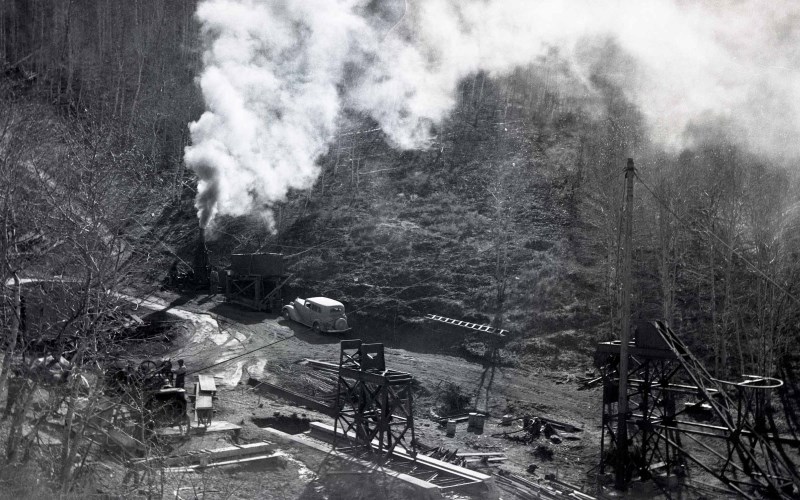
Crews build the Proctor chairlift in an area that offers plenty of aspen color in fall for hikers. PHOTO: Sheldon Zadoc Thayer
|
|
|
Proctor Mountain offered challenging skiing for the expert skiers and access to back-country skiing that was an important part of Sun Valley’s offering. Skiing was a fledgling sport in 1936. There were few ski lifts in this country, so one had to be physically fit enough to hike, herringbone or use skins to climb up hills before skiing down. Equipment was rudimentary, there were few formal ski lessons, and the sport involved more backcountry mountaineering than downhill skiing. The opening of Sun Valley with chairlifts created by Union Pacific engineers changed things. In fall 1935, Averell Harriman, the chairman of the board of Union Pacific Railroad, had a radical plan to restore rail passenger train service that had been decimated by the Great Depression (“collapsing like a rotten trestle,” according to railroad historian Maury Klein). Harriman had begun restoring passenger service by introducing Streamliners, a modern new train system for high-end travelers, and the Challenger for the budget-minded. Rail passenger travel rebounded--he now needed a new place for them to go, especially in the winter.
|
|
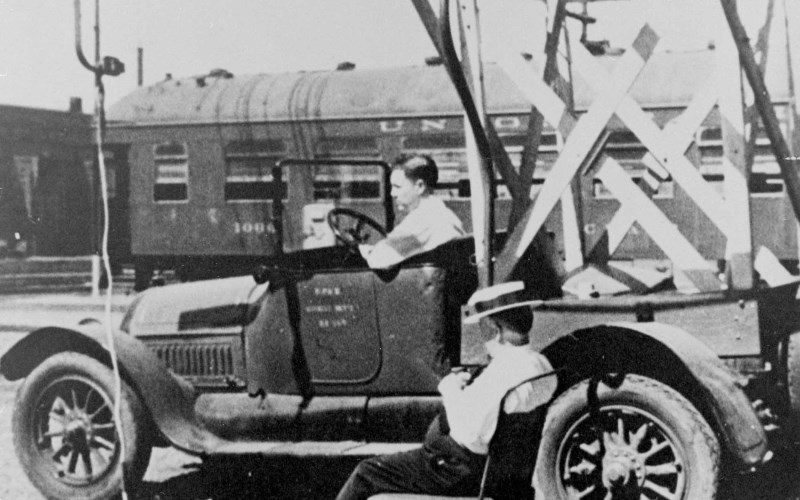
Union Pacific engineers test chairlift designs in Omaha, Neb.
|
|
|
His radical idea - build a destination ski resort in the West in an area served by Union Pacific. Harriman asked Austrian Count Felix Schaffgotsch, whom he knew from Europe, to tour the West to find the best place for a ski resort in a location served by Union Pacific. After exploring most of the areas that later became ski resorts, the Count was shown the area around Ketchum, served by a Union Pacific spur line from Shoshone. The Count told Harriman, “This without doubt is the perfect place... Among the many attractive spots I have visited, this contains more delightful features for a winter sports center than any other place I've seen in the United States, Switzerland or Austria for a winter sports resort.” In February 1936, Harriman inspected the area around Ketchum, saying, “I fell in love with the place then and there.”
|
|
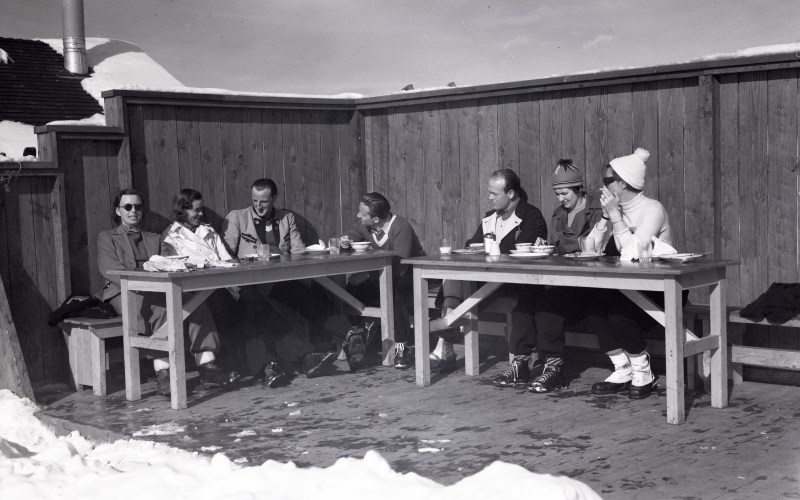
Marie Harriman, Franz Epp, Max Hauser and others enjoy lunch in the sun on the deck outside the Proctor Cabin.
|
|
|
He moved quickly to build his ski resort there, seeking the advice of two men with long experience in the ski industry--Charles N. Proctor and John E.P. Morgan. Harriman asked them to gather information about the economics of skiing in the United States and hired the men to select locations for Sun Valley’s ski lifts and lay out its ski runs. Charles N. Proctor was captain of the Dartmouth ski team in 1927 and a member of the 1928 U.S. Olympic team, competing in cross-country and jumping. He coached Harvard’s ski team, and was in charge of ski trail design for the Forest Service, working at Cannon Mountain and Pinkham Notch. He ran a ski store in Boston and was a judge at the National Downhill and Slalom Championships and Olympic Team tryouts on Washington’s Mount Rainier in 1935. John E.P. Morgan was an avid skier and hockey player after World War I, an administrator of the 1932 Lake Placid Olympics and a “fellow banker” friend of Harriman’s.
|
|
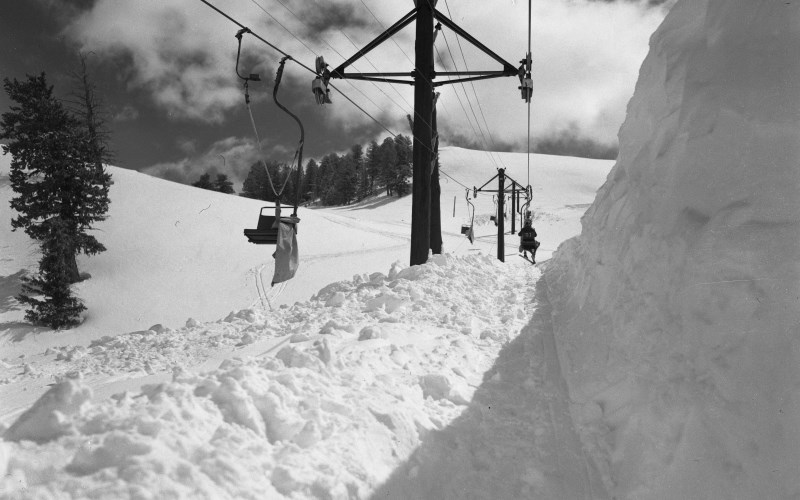
Workers had to dig a trench to allow the Proctor Mountain chairlift to get through the snow.
|
|
|
Beginning in late February 1936, Harriman moved with lightning speed to build his ski area, committing Union Pacific money to the project well before the railroad’s Board of Directors approved the project in May. “From then on, the preliminaries of the building of Sun Valley moved with a swiftness unbelievable to the easy-going residents of the region,” wrote Sun Valley publicist Dorice Taylor. Land was acquired, the resort was planned and the lodge and ski lifts constructed in the wilderness of Idaho between March and December 1935, a tribute to Harriman’s leadership and the capabilities of Union Pacific engineers. Harriman played the role of Commander in Chief in New York. He hired Morgan and Proctor to work with Union Pacific engineers on logistical planning for the new resort and had Union Pacific lawyers buy the 3,888-acre Brass Ranch outside of Ketchum for $39,000 or just under $10 an acre.
He hired a core team for his project: Steve Hannagan, a successful publicist known for “turning a mosquito infested swamp into Miami Beach--a playground for the rich;” architect Gilbert Stanley Underwood, who designed the Sun Valley Lodge, and J.V. McNeil Company of Los Angeles to be general contractor. Roberta Brass took Proctor on horseback around the ranch that Harriman had purchased for his resort, exploring what locals called Back Pay Mountain. Proctor liked the mountain and decided to use it for the resort’s expert ski area. Proctor and Morgan determined the mountains closest to the Lodge (Dollar and Back Pay) were the best to develop for skiing since they were not too steep. They examined Bald Mountain but rejected it as a ski site, since at 9,150 feet, it was considered too high, and there were few skiers in the country at the time who could handle its steep slopes, terrain and elevation. In Omaha, Neb., Union Pacific engineers evaluated all possible systems for ski lifts, including rope tows, a J-bar, an up-ski toboggan similar to that at Yosemite, cable cars and a cog railway.
Jim Curran, a young Union Pacific engineer, had previously worked for Paxton-Vierling Ironworks, where he designed a conveyor system to load bananas onto ships using hooks attached to an over-head cable. He came up with an innovative idea--a chairlift that carried a single skier per chair, based on his mono cable system for bananas. Charles Proctor convinced Harriman to use the system, and he ordered Union Pacific engineers to develop a chairlift system for Sun Valley. Union Pacific engineers developed a model for the chairlift at their facilities at Omaha, using an old pickup truck and a chair hung on a cable to experiment with moving parts. John E.P. Morgan helped determine the appropriate speed for the chairlift system, experimenting with skis sliding on straw and roller skates. American Steel and Wire Company of Worcester, Mass., had built the country’s first J-bar in 1935 for the Dartmouth Outing Club, and it fabricated the bullwheels, cables, sheaves and other components for the Sun Valley chairlifts. The company helped install the chairlifts at Sun Valley in 1936 and, later, the three chairlifts on Bald Mountain for winter 1940.
The company was listed as one of the inventors of the Sun Valley Aerial Ski Tramway when it was patented in 1937, and Averell Harriman later recognized contributions made by his associates to Sun Valley by naming mountains for them. Back Pay Mountain was renamed Proctor Mountain for Charles Proctor, becoming Sun Valley’s expert hill when it opened in 1936. Morgan Ridge, an advanced ski run on Proctor Mountain, was named for John E.P. Morgan. Schaffgotsch Mountain, believed to be just north of Warm Springs Canyon, was named for Count Felix Schaffgotsch. Durrance Mountain near the present Sawtooth National Recreation Area headquarters was named for Dick Durrance, who won the first Harriman Cup in 1937. Bright Mountain, next to Durrance Mountain, was named for Alex Bright, a member of the Sun Valley Ski Club Board of Directors and a member of the 1936 U.S. Olympic hockey team. And Hauser Mountain at the north slope of Lake Creek was named after Hans Hauser, Sun Valley’s first Ski School director.
In July 1936, Union Pacific crews began installing the first chairlifts in the world on Proctor and Dollar Mountains. Union Pacific engineers were experienced in building virtually everything and were used to improvising and being creative. Since the chairlifts were invented for Sun Valley, no one had experience installing them. So, Union Pacific’s engineers had to figure out how they should be put together and work. Lloyd Castagneto, Union Pacific’s Bridge and Building supervisor, directed the operation. Castagneto had no plans for the chairlifts so, he said, he and his initial crew of 100 had to “build what they sent me.” The lift towers were creosoted wood, unlike later ones that were steel. By October 1936, concrete bases were poured and the lift poles were set. The big drive wheels (bull wheels) and the wooden lift towers were man-handled up the mountains to their proper locations, dragged by tractors using a special trailer built for them.
Crews installed the chair lifts “the hard way, by manual labor,” said Val McAtee, who worked for Castagneto. “We didn’t have all of the fancy machines that we had later.” Initially, a rope was attached to the chairs for skiers to grab. This allowed them to be pulled up to the speed of the chair before sitting down. But, according to Ed Seagle, Union Pacific’s project engineer for Sun Valley, the ropes would catch in the snow after the skier sat down, twirl around and end up twisted around the cable. The chairlift would have to be stopped to remove the rope so ropes were discarded after about a month.
Since Proctor Mountain faced north and was cold, it made an unpleasant trip for skiers riding the chair. So, Seagle decided blankets should be given to those riding the chairs to keep them warm, and Sun Valley Resort kept that system in place for years. On July 22, the Hailey Times said work had begun on a new road up the hill to reach the base of a tram about a mile up Trail Creek. By the end of November 1936, the Proctor Mountain chairlift was finished and ready to be tested, although problems emerged, as described by The Hailey Times: “Tram Balks With Ladies High in Air.” On this occasion, 20 female volunteers were loaded on the lift. Some of the ladies waved to the crowd of onlookers, while others gripped the bars attaching the chairs to the moving cable until their knuckles blanched. Suddenly the lift motor stalled, leaving the women suspended like so many bunches of bananas.
The nervous women were lowered down with ropes as Curren frantically searched for the cause of the stoppage, which turned out to be a blown fuse. Once it was replaced, none of the women were willing to try the lift again. The resort manager ordered his secretary, Florence Law, onto the lift. This time, everything worked perfectly, making Miss Law the world’s first official chairlift passenger. Lift controls were located at the top of the chairlifts. There were auxiliary push buttons at the bottom of the lifts and a telephone connecting the top and bottom operators with each other and with the lodge. A warming hut, the Proctor Mountain Cabin, was built near the top lift station, below the crest of the hill. It was a 20- by 30-foot building with a waxing table, work bench, lunch counter, benches and rest rooms.
Here the expert skiers could rest, repair their skis and make ready for the hazardous rides that the vicinity of Proctor Mountain afforded, according to one publication. The cabin had a restaurant called the Hot Potato, and the cabin was later known as the Hot Potato Hut. Sun Valley ski instructor Florian Haemmerle cooked there after 1938. When the Proctor chairlift was removed and taken to Baldy in 1951, the mountain was no longer used as advanced skiers preferred Baldy. Thus, the Proctor Mountain Cabin was moved to serve as the Sun Valley Gun Club cabin. Sun Valley’s chairlifts revolutionized skiing, influencing what was done elsewhere in the country, according to ski instructor Otto Lang: “Credit must be given to the engineering department of the Union Pacific...for coming up with a solution. Thanks to the ingenuity of one staff engineer, James Curran, the problem was solved. Skiers around the world should be eternally grateful to him for his invention of the chairlift—perhaps, the most popular, efficient and universally accepted mode of uphill transportation for skiers and summer sightseers.”
The Seattle Times of June 6, 1937, said “Skiers are not made by climbing hills. Skiers develop proficiency by coming downhill. Skiers at Mount Rainier can get in around 4,000 feet of skiing a day. At Sun Valley, with its chairlifts, a skier can get in 37,000 feet a day.” “Now, you could finally ski downhill all day long and never have to climb back up,” said filmmaker Warren Miller. “Just sit down in a moving chair and be hauled back up for as many rides as your strength, skill and money allow. All...for only a couple of dollars a day.” EDITOR’S NOTE: Learn how a J-Bar took skiers to the Proctor Mountain chairlift when John W. Lundin’s story continues in Eye on Sun Valley on Sunday, Jan. 4. John W. Lundin, a lawyer and historian, has written several history books on skiing, including “Ski Jumping in Washington State,” which won a 2022 Skade Award.
|