|
STORY AND PHOTOS BY KAREN BOSSICK The Camas Prairie near Fairfield looks different than it did 150 years ago. Dense blue-purple flowers that were once so thick European immigrants mistook them for a lake now only bloom in scattered patches. The invasive garrison grass that blankets much of the prairie now can grow taller than a person. It chokes out the light. It mats the soil, creating a dense thatch that stymies the camas’ growth. And it is slowly winning a battle that the Shoshone-Bannock people have been fighting since before most of those now living in the Wood River Valley were born.
|
|
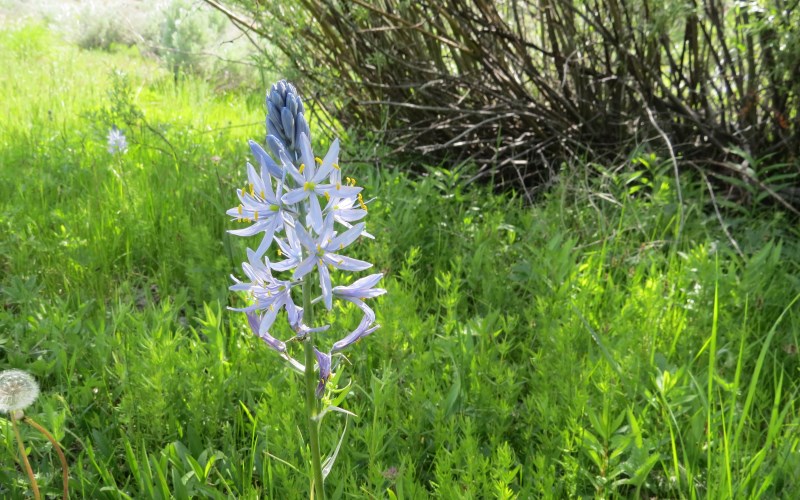
The camas used to be classified in the lily family until science determined it is actually a member of the asparagus family.
|
|
|
Two Shoshone-Bannock women from the Fort Hall Indian Reservation in southeast Idaho came to The Community Library in Ketchum recently to talk about what they are trying to do about it. Bailey J. Dann, who works in the Tribe’s Language and Cultural Preservation Department, and Sidney U. Fellows, who works on a diversified seed and vegetable farm near Stanley, Idaho, told of their relationship with the land. "Camas is our relative," Dann told the audience. "When we harvest the camas bulb, we recognize the sacrifice that that being makes so that we can live." The Shoshone-Bannock name for camas is pasigo. The name for the valley the prairie occupies is Yampadai. In their language it means “wild carrot hole,” referencing a memory of a time when wild carrots grew alongside the camas in abundance.
|
|
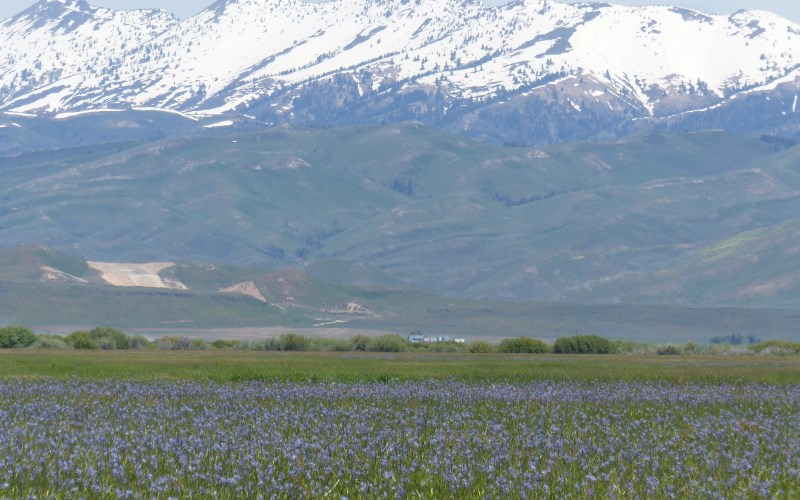
One Shoshone or Bannock woman could harvest 50 pounds of the onion-shaped camas bulbs a day before cooking or steaming them, drying them and grinding them into a flour.
|
|
|
Fellows, who grew up on the Fort Hall Reservation and now works with the Rodale Institute, began the evening by asking the audience to imagine the Wood River Valley before Atkinsons Market and before the Oregon Trail had rewritten the landscape. She led the room through a quiet visualization, asking them to imagine standing knee-deep in a wetland where the camas grew to belly-button height, red-winged blackbirds nested in the sedges, pollinators moved through the flowers and small mammals turned the soil. It was a living place. A tended place. A garden thousands of years in the making. The Shoshone-Bannock people did more than forage at Yampadai. They cultivated, as well. Harvesters selected the largest bulbs and left the smaller ones to seed the next generation. They created air pockets in the soil that fed the microbes. They managed with fire. They moved with the seasons and the blooms in a rhythm so precisely tuned that the prairie itself reflected it, growing dense, diverse and alive in ways that Western agricultural science is only beginning to understand.
|
|
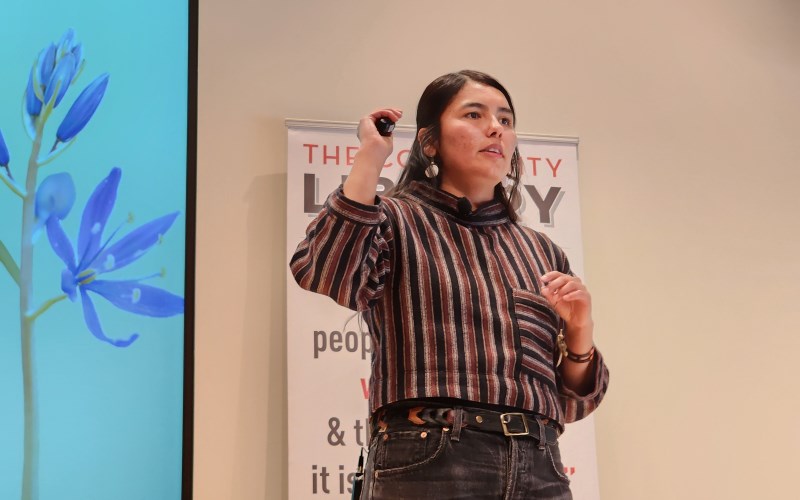
Sidney U. Fellows said Tribes have a short time to harvest the bulbs, as they don’t want to mistake the blue camas for the white death camas.
|
|
|
The Shoshone-Bannock harvested with a digging stick called a bodo. It was made of hardwood, fire-hardened at the tip, with an antler handle designed to redistribute body weight so the digger did not damage the roots beneath. The bodo is thousands of years old, yet Fellows carries one in her car. "When I speak with students, I ask them what they notice," she said, holding it up. "They ask: Is it burnt? Yes. Fire-hardened hardwood carbonizes. It creates a strong exterior that is beneficial to the soil microbes." She smiled. "I also found it's excellent for keeping your husband in line." The laughter settled, but the history did not.
|
|
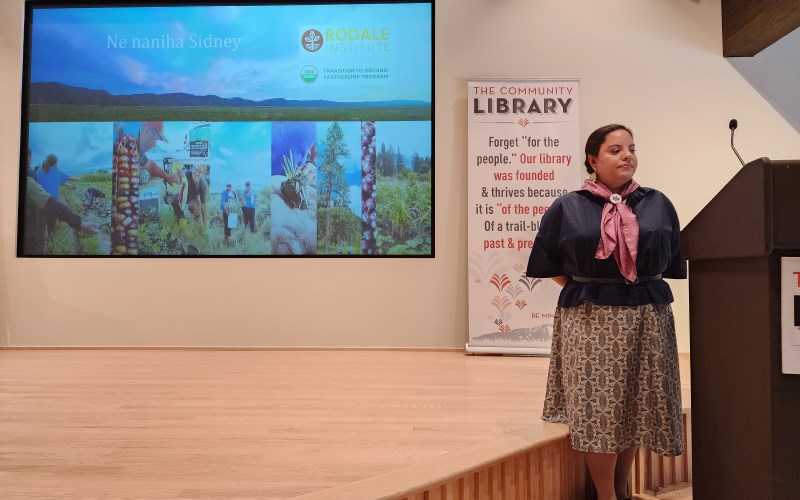
Bailey J. Dann, a descendant of Chief Pocatello, said “We only take what we need. We aren’t greedy people.”
|
|
|
Dann read a speech she had first delivered to the Idaho State Legislature and adapted for the Ketchum audience. She spoke of ancestors who lived in the Wood River Valley, whose bones remain in the crevices of the rocks in this valley. She spoke of the Fort Bridger Treaty of 1868, which the Bannock and Shoshone leaders signed believing it reserved Yampadai as their homeland for the gathering of camas. She spoke of a clerical error--the treaty copy that arrived in Washington before the original said, “Camas Prairie,” and settlers used the ambiguity to justify moving in. And she spoke of the Bannock War of 1878. It was fought just 10 years after the treaty was ratified when tribal warriors watched their children starving while pigs and cattle destroyed the camas fields. "Our ancestors fought for this resource," Dann said. "We call this restoration project ‘the Second Bannock War.’ "
The boarding school era compounded what settlement began. Children were removed from their families and beaten for speaking their languages. The knowledge encoded in those languages, including the knowledge of how to care for Yampadai, was nearly lost with them. Dann is the first person in her family, across three and four generations on both her mother's and father's side, to speak and practice the Shoshone dialect and cultural ways. "Language encodes memory and ecology," Fellows said. " ‘Yampadai,’ for instance, means ‘wild carrot hole.’ That word remembers what the valley once held." What the Camas Prairie Centennial Marsh now managed by Idaho Fish and Game now holds is garrison creeping meadow foxtail, an invasive pasture grass that farmers planted for cattle and erosion control and has since spread across camas habitat in dense, rhizomatous mats.
Fellows displayed a side-by-side photograph. One side showed the prairie in 2008 full of pasigo. The other taken three years ago was nearly void of the blue camas flowers. Fellows held up a sample of the foxtail that she called “a prisoner of war.” It can grow six feet tall, she said. The restoration project brings together a coalition comprised of the Tribe, Idaho Fish and Game, the Nature Conservancy, Idaho State University, the BLM, the Northwest Center for Alternatives to Pesticides and volunteers. Native Americans want food for future generations and a restored relationship to the land. The state agency wants wetland function. The researchers want ecological data.
The work of aligning those goals, Fellows said, has been both beautiful and hard. On May 29, the tribe is hosting a citizen science workshop at the prairie open to the public. Anyone who wants to understand the scale of what is being asked of this landscape is welcome to come pull garrison grass alongside tribal members. The work, Fellows said, is decades ahead of them. "Camas brings people together," Dann said. "A hundred and fifty years ago it was our ancestors gathering at Yampadai from all across the Pacific Northwest. The Shoshone Paiute, the Burns Paiute, the Nez Perce. Trapper journals counted lodges in the thousands. Today it's still bringing people together. It just looks different."
The two women closed with a concept offered by a tribal elder: We all exist as one. "We can't go back and undo those harms," Dann said. "But we can acknowledge those wounds. And then we can move forward together with healing. Because we're all here. We live here together."
|