|
STORY AND PHOTOS BY KAREN BOSSICCK
The U.S. Navy’s Growlers screamed by hundreds of spectators out in the Idaho desert, traveling 700 miles per hour or about two-thirds of their top speed of 1,190 miles per hour.
The two Boeing EA-18G electronic warfare aircraft, known for radar jamming that can blind enemy aircraft, climbed four miles per minute in the sky, then crossed paths within feet of each other as they performed Cobra and other maneuvers.
Twenty-four hours later the two aircraft from Whidbey Island in Washington would crash as the trailing Growler closed in too fast, their 44-foot wingspans looking as if they had become entangled. The four airmen aboard safely ejected as the planes hurtled toward the ground, crashing in a fireball and sending black smoke up in the sky.
|
|
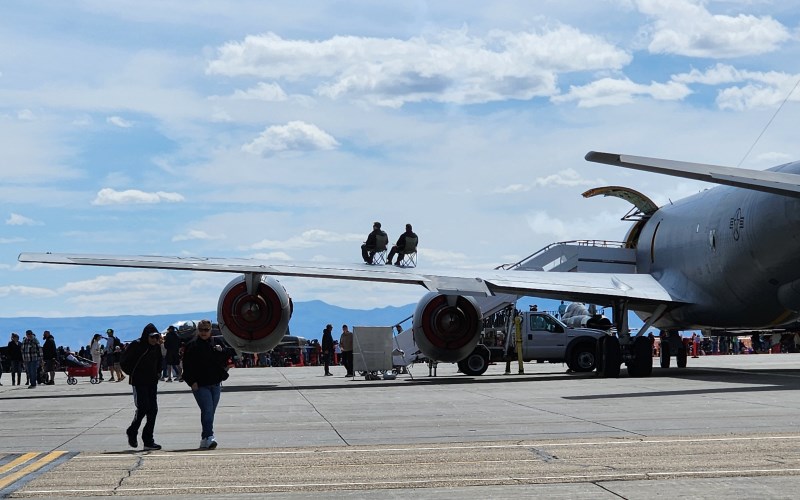
Two service members waited not in the wings but on the wing as they watched the show.
|
|
|
But that didn’t happen on Day One of the two-day Gunfighter Skies Air Show presented by the Mountain Home Air Force Base 366th Fighter Wing.
Those attending the first day of the air show in what’s dubbed “Gunfighter Country,” got four hours to watch the precision and capability of the U.S. Air Force in the royal blue Idaho skies.
They got to chat with service members while climbing in and out of tanks. They watched a robot disarm ordinance. They got to see such planes as the Boeing B-52 Stratofortress up close and personal.
And they got to watch two dozen young men and woman take the oath of office as they prepared to join the U.S. Air Force.
|
|
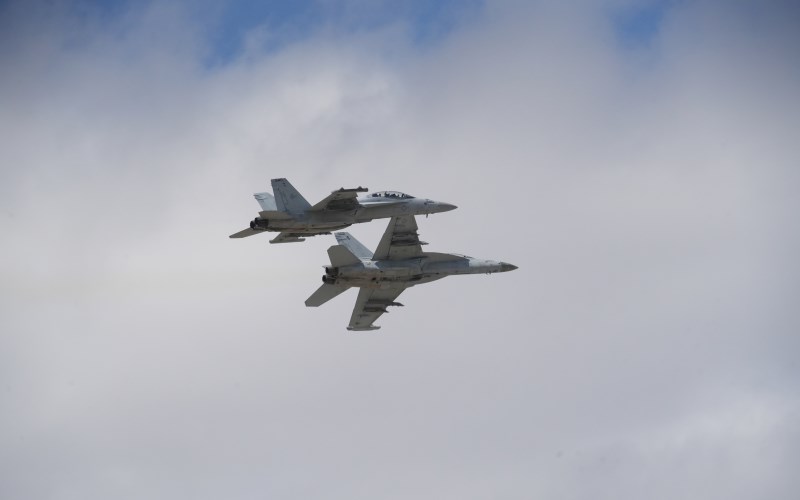
The Growlers flew without mishap on the first day, but one pilot had to be hospitalized following a crash on the second day.
|
|
|
Lt. Kevin Lynch described how the Growler is the only electronic attack aircraft in the nation’s Department of Defense.
“We can detect radar signatures,” he said. “And we use our own pod to jam those radars so we are undetectable.”
Parachute jumpers pulled on their suits, fully prepared to showcase their skills in the skies. But they would not be allowed to jump that day as vigorous winds swept the entire American West.
“All we need is 1 and a half minutes of calm. But not today,” one said.
|
|
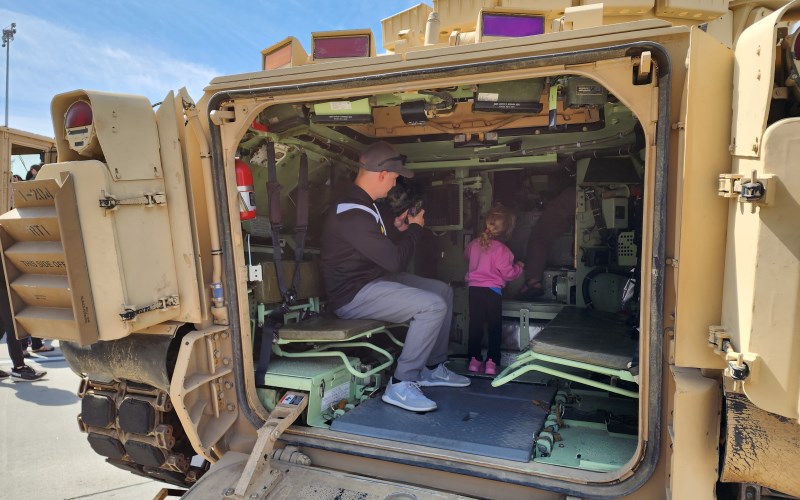
A father took a picture of his daughter exploring a Bradley Fighting Vehicle, which can travel 300 miles over all kinds of terrain on 175 gallons of fuel. The models are quipped with a machine gun and missile launcher.
|
|
|
Mountain Home’s six F-15E Thunderbolts, each capable of carrying a 22,923-pound payload of air-to-air missiles, precision-guided bombs and tactical nuclear weapons, lined the runway.
The show’s highlight, they performed such flying maneuvers as formation flying and the four-ship Diamond formation in a highly choreographed show that even showcased the work of the crew members who prepared the planes.
The Smoke ‘N Thunder jet car raced down the runway accelerating from 0 to 400 mph in 9 seconds as it burned 30 gallons of fuel per run. The driver challenged aircraft above to a race and he sometimes won, deploying a parachute at the end to take the load off the brakes.
Logan, Utah’s frequent flier Brad Wursten performed flip tops and other stunts that had to have taken their toll on his body, while Mark Peterson blew smoke circles with his A-37 Dragonfly.
|
|
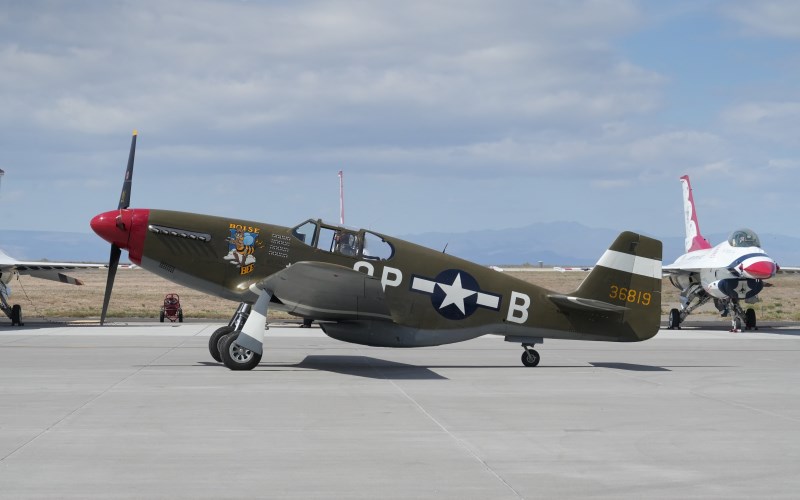
The Boise Bee was one of the P-51 Mustangs whose speed meant that more pilots returned home from their missions.
|
|
|
The announcer described how Peterson considered flying a P-51 akin to flying a National Monument.
“Someone once told Mark that you don’t ever really own a Mustang or any other warbirds,” he said. “You’re just lucky enough to take care of it for the next generation.”
The P-51 Mustangs changed the trajectory for American pilot fighters when they entered World War II. Before the P-51, seventy-five percent of bombers did not return to their base following a mission. But the P-51s emerged as the fastest pilot aircraft in World War II.
And the Boise Bee, which is housed at the Warhawk Air Museum in Nampa, was there to represent that slice of history, its pilot zig-zagging down the runway since pilots can’t see if there’s anything in their path if they cruise straight ahead.
If you missed it last week, you can see it fly in a Memorial Day and at the Warbird Roundup Aug. 29-30 at the Warhawk Air Museum.
|