|
BY KAREN BOSSICK
Kevin Caldabaugh was picking up wraps from Wrap City for his kitchen staff working on the Valley Club’s biggest golf tournament of the season when he first spotted the smoke.
It was right about 2 p.m. on Saturday, July 18, and it was the final day of Moose Madness, a three-and-a-half-day tournament that serves as the pinnacle of summer at the private club just north of Hailey.
The main rounds were finished. The "horse race" playoff was about to begin, where the top teams from all 18 flights compete in a knockout format, each hole narrowing the field from 18 teams down to two while members crowd the course to watch and place friendly bets.
|
|
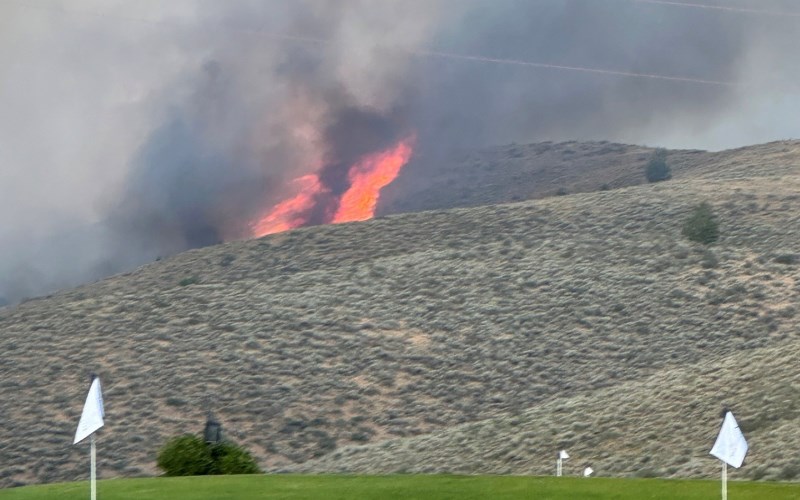
Kevin Caldabaugh captured this picture of the fire behind the Valley Club’s driving range.
|
|
|
A band called Calico Dreams had spent six hours setting up for the evening celebration. And the culinary team had an outdoor kitchen ready to feed roughly 400 people.
There was sushi. And there was sashimi.
Caldabaugh pulled in through the north entrance and glanced toward Ohio Gulch.
"Huh, there's a fire going on over there," he thought. "That doesn't look good." Then, in the next breath: "Yeah, but I'm sure they'll take care of it."
|
|
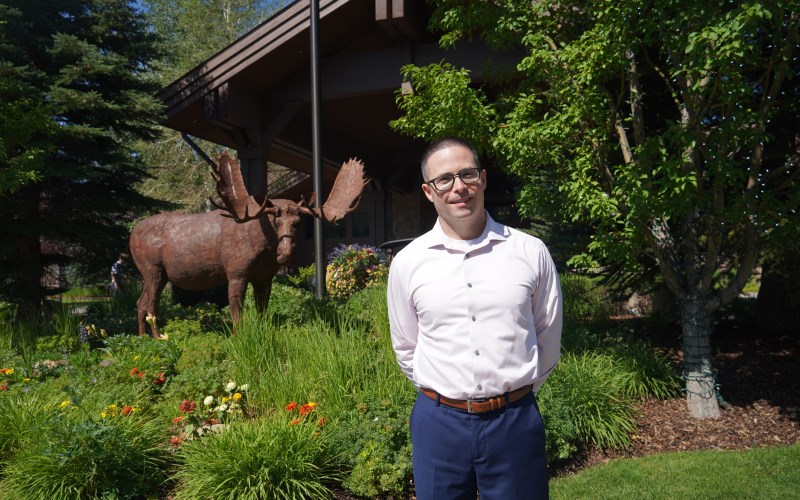
Kevin Caldabaugh credited his experience evacuating Florida golf courses during five hurricanes for helping him address the Ohio Gulch Fire. PHOTO: Karen Bossick
|
|
|
Thirty minutes later, smoke was billowing up behind the ridge. Caldabaugh and Director of Golf Jake Hanson drove out onto the North Six hole to get a better look. While they stood there assessing the situation, every phone on the property went off simultaneously.
“Level three evacuation. Get out now.”
It was just after 2:30 p.m. The Ohio Gulch Fire, started by a Los Angeles man shooting into a sagebrush-covered hillside just 1.2 miles from Highway 75, was bearing down on the Heatherlands, Indian Creek and—yes—the Valley Club.
What happened over the following 48 hours at the Valley Club is a story of crisis management, community spirit and one general manager whose unlikely background — evacuating golf clubs in South Florida during five hurricanes--gave him exactly the instincts he needed when wildfire came to his golf club in the high desert mountains near Sun Valley, Idaho.
|
|
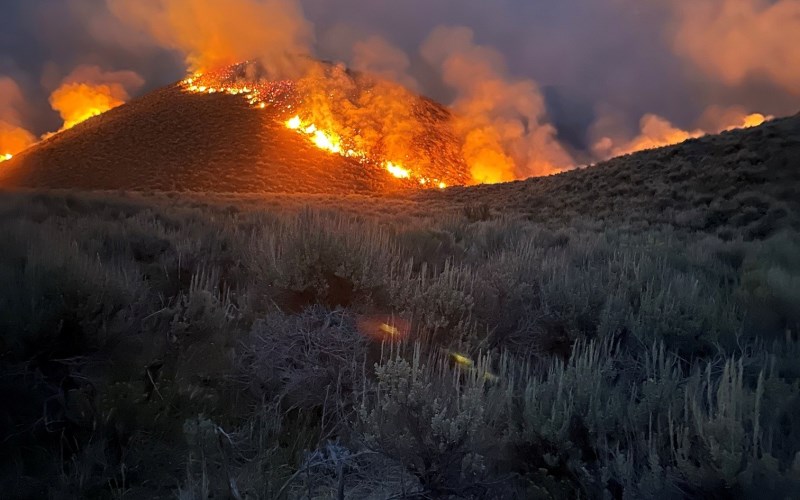
This was the view of the fire from the Valley Club as night set the day the fire started on July 18. PHOTO: Kevin Caldabaugh
|
|
|
"Preparing a club for a hurricane, you get more time to prep," Caldabaugh said. "A fire, you don't have the time to prep. But the response in coordinating with your different department heads and the other key stakeholders that are involved — very, very similar to preparing and being involved in a hurricane in Florida. I think had I not had that exposure, it would have been harder to figure out quickly how to respond in this situation."
Once the evacuation order came, Caldabaugh called each department head individually. Most were already at the clubhouse. He told them in person: “We've got to evacuate.”
Hanson announced the instructions over the loudspeaker system so every tournament competitor on the course could hear. Fred Hartzman, director of the West Campus, mobilized his entire team. The instruction was simple and clear: “Secure your department, get everyone out and text me so I know you're safe.”
It was essentially a ski patrol sweep. Valley Club personnel drove through the property making sure no players were left behind. Volunteers helped get golf carts back to the clubhouse. Everything was left as organized as possible under the circumstances.
|
|

Even on Friday morning—three days after firefighters had contained the 2,035-acre fire—golfers could still see smoke rise beyond the driving range. It was out by that afternoon. PHOTO: Karen Bossick
|
|
|
Calico Dreams tore down their six-hour setup in about 15 minutes.
While most of the staff evacuated, a handful stayed behind. Golf course Superintendent Jason Sigmund and his assistant Ken Thornock remained at the club for 48 hours straight, watching the property, protecting the equipment building that housed the club's substantial investment in golf maintenance equipment and standing ready to help firefighters.
They ran sprinklers on the driving range all night long to soak it, making it too wet for fire to approach. They provided the firefighters with gas-powered, off-road utility vehicles known as Gators so crews could navigate the sagebrush more easily. They drove firefighters out to the fire line.
And then there was the food.
The club had a feast prepared for 400 members that could no longer be served. So, Caldabaugh's team set up a tent at the base of the driving range and turned it into a fueling station for the firefighters.
Cold cuts, cheese, chips, crackers, bananas, apples, cookies, brownies — all packed on ice. Cokes, Gatorades, water. Nothing fancy, but enough to keep firefighters going through the night.
The sushi and sashimi didn't survive.
By Sunday morning, when Blaine County fire leader Mike Elle called to say a small team could come in temporarily to reorganize, it was too late to save the raw fish.
From the Valley Club's vantage point, the scene Saturday evening was both terrifying and awe-inspiring. Just before 9 p.m., the sky behind the driving range looked angry. Smoke and flame rose behind the ridge as air tankers dropped retardant to protect the range while water arced over the green from every sprinkler the crew could activate.
Firefighters cut a fire line with a bulldozer along the backside of the ridge and, then, they purposely lit the sagebrush on fire, creating a backburn that marched toward the main fire. When the two fires collided, they extinguished each other.
Caldabaugh was on site until about 10 p.m., returning at 8:30 a.m. the next day. His team worked for roughly six hours reorganizing the club, then left per the firefighters' wishes.
Throughout the crisis, Caldabaugh maintained steady communication with the club's 768 members, relaying updates he received from Mike Elle and BLM's John Kurtz, who had asked if his team could use the Valley Club as a base of operations.
Caldabaugh didn't hesitate: "Yeah, of course, absolutely. Do whatever you need to do. We want to give you guys the best chance possible to stop this thing."
When a man called from Denver asking authorization for helicopters to use the club's ponds to scoop water, Caldabaugh had already evacuated and had no access to a printer. "Can you accept an email, me saying ‘Yes, use our ponds?’ " he asked.
That was good enough.
One homeowner living near a pond estimated the helicopters came to fill up 70 to 80 times over the course of the event.
"It's amazing how precise they can be, dropping water over a fire line," Caldabaugh said. "And to see the 737s come in — these are massive planes — and the precision with which they can drop fire retardant is unbelievable. It's really pretty special, to be honest."
What Caldabaugh didn't know at first was the scope of the response. He assumed the local team was handling it alone. Then he learned firefighters had come from Oregon, Nevada, Utah and all parts of Idaho.
"Everybody came here to protect us, which really was amazing," he said. "And they didn't think twice about it. They just came here to do their job, and they did it extremely well."
On the following Wednesday—a day after the fire had been contained at 2,035 acres--the Valley Club held its regular staff meeting and conducted a full debrief on the fire response — another page from Caldabaugh's hurricane playbook. The goal was to identify small improvements for the future, although the team felt they had performed as well as they possibly could under circumstances they had never trained for.
Perhaps the most memorable gesture came from Director of Golf Jake Hanson, who decided the firefighters should be recognized as the honorary Moose Madness champions. He invited a group of firefighters back to the club, where they posed in front of the Valley Club's signature moose statue, holding the tournament trophies.
They didn't get to keep the trophies. But they got the photo.
Standing outside the clubhouse six days after the fire started, watching members practice on the driving range where a small tornado of smoke still hovered in the distance, Caldabaugh reflected on what the experience revealed.
"Blessed, grateful, thankful, proud," he said. "I feel a strong sense of community. When you go through an experience like this, it strips away everything else that's not really truly important in life. And it's relationship, it's community — those are the things that last beyond any natural disaster, any circumstance that brings a trial to a community."
The biggest relief, he said, was that nobody got hurt and no structures burned. From the Valley Club's vantage point, the staff felt the club itself would be safe. Their greater concern was for neighbors on Indian Creek and the north side of Ohio Gulch.
"We were, collectively, I think the concern from our vantage point was more about what's going to happen to them," Caldabaugh said.
In the end, it was another page in the scrapbook for the Valley Club, which was founded in 1996 by a group of golfers who, facing capacity issues at existing courses, decided to start their own club so they could play whenever they wanted.
Today the club has 768 members and a waiting list.
On that Saturday in July, the course that began as a simple place to play golf became something more — a staging ground, a refueling station, a water source, and a reminder that when disaster arrives, community shows up.
Even if the sushi didn’t survive.
|