|
STORY AND PHOTOS BY KAREN BOSSICK
Benjamin Beilman’s legendary Guarneri del Gesu violin has its own passport. And it has to go back to Japan yearly for its passport to be renewed.
But that’s preferable, Beilman said, to taking the chance that it could be confiscated as one violin was in Frankfurt, Germany, because custom agents feared it was being smuggled.
Beilman’s 1740 violin has been played by a long list of legendary violinists, including Belgian virtuoso and composer Eugene Ysaye, Itzhak Perlman, Isaac Stern and Charles Monk. And those attending the Sun Valley Music Festival’s Winter Festival through Saturday at The Argyros in Ketchum can see just how the violin and Beilman complete one another.
|
|
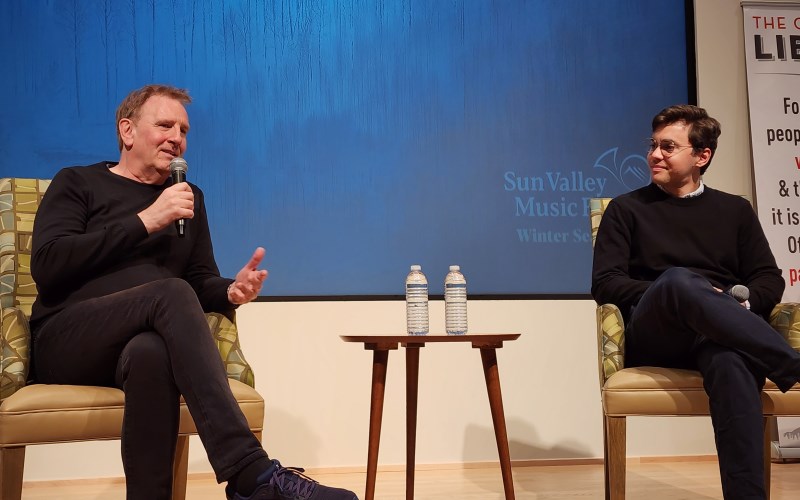
Benjamin Beilman told Alasdair Neale that he brought his family, including his young son with him and they are spending time in Little Park and playgrounds around Ketchum.
|
|
|
“I have played on some very, very fine instruments, but this is my favorite without a doubt,” he said.
Beilman told those attending an Upbeat with Alasdair conversation Wednesday night at The Community Library that he had applied to the Nippon Music Foundation for the loan of one of its 25 Stradivarius instruments, which are prized for their rarity, superior tonal quality and historical significance.
But he and the Stradivarius didn’t quite jive. And, when it needed a few adjustments, the Japan-based Nippon Music Foundation, known for its Instrument Loan Bank, offered the use of the Gesu violin.
“I picked it up, felt the power, the soul, the history—everything was there,” Beilman said.
|
|
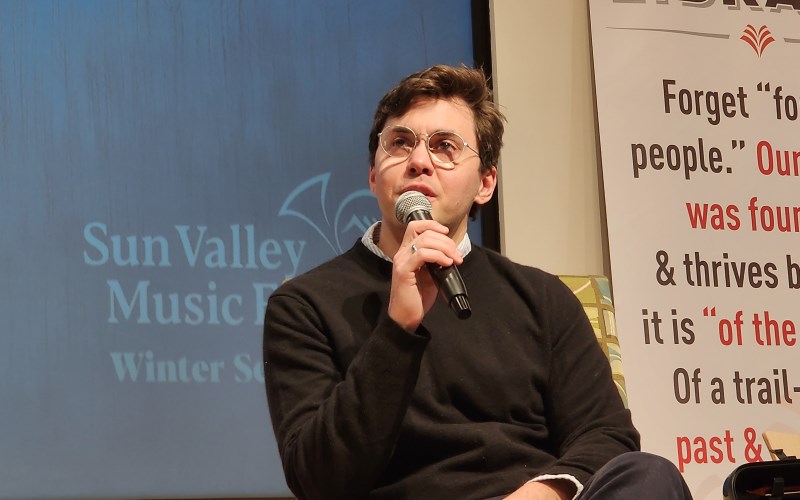
“He loves watching me practice,” Benjamin Beilman said of his son. “I practice less but better.”
|
|
|
The Stradivarius only resonates if you play it quietly with a delicate, gentle delivery, he explained. The other violin allows you to play any way you want, responding well to aggressive playing, as well. It sounds angelic and it can sound smoky or full-throated.
“Best of all it’s easy to play.”
The violin is in good hands. Beilman is considered one of the leading violinists of his generation with The Strad praising his performances as “pure poetry.” He brings surprise to his playing, uncovering new expressions in familiar works.
He’s performed with the Berlin Philharmonic, Philadelphia Orchestra, London Philharmonic, San Francisco Symphony and other major orchestras throughout the world. And in 2022 he became one of the youngest artists to be appointed to the faculty of the Philadelphia-based Curtis Institute of Music, which educates exceptional young musicians.
|
|
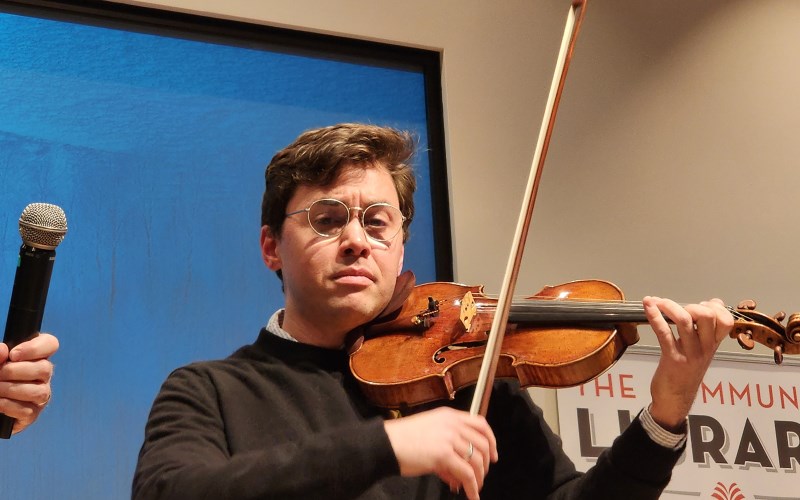
The violin, originally bright red, has an inscription inside from composer Eugene Ysaye that says, “his instrument was my faithful companion throughout my career.”
|
|
|
Beilman curated this week’s Winter Festival menu featuring Aaron Copland’s “Appalachian Spring Suite,” John Adam’s “Road Movies” and Vivaldi’s “Four Seasons.” He will also perform a solo violinist piece titled “Sanguineum” written for him by Gabriella Smith.
His opportunity to curate the Sun Valley Music Festival’s eighth Winter Festival was hatched when Beilman ran into Sun Valley Music Festival Music Director Alasdair Neale at a dinner party following a Seattle concert featuring today’s foremost violinists.
“I had played here in 2018 and I remember lying on the lawn outside the pavilion looking at the stars and taking hikes. So, I knew nature had to be first and foremost,” Beilman said of including “Four Seasons” in the program.
The Copland piece pays homage to America 250th birthday. And the solo violin piece was written by an environmental advocate whose music is rooted in nature.
“Road Movies” conjure the idea of settling into the right lane of a highway cruising along, Beilman said. “And I’ve been dying to play a piece by John Adams who is the greatest American composer right now.”
Beilman said he first became enamored of the violin as a three-year-old sitting on the floor playing with his trucks and trains as his sister, who was two years older, sawed away at “Old MacDonald Had a Farm.”
He began taking lessons at 5 and remembers carrying a violin made of a macaroni box to a pizza box marking the center of a stage as he learned about performing. His mother knew nothing about violins, but she attended every lesson, taking notes, like “Put your finger on the string this way….”
At 10 Beilman decided to pursue a career as a violinist over that of a professional soccer player.
“I realized that if I became a pro soccer player my career would be over by 32 but that a career as a violinist would last longer,” he explained. “I perceived that I was good at it, as people were responding positively.”
His family moved from Atlanta to Chicago to pursue more music education for their son. And Beilman played in his first chamber concert at 11.
“I went to a normal high school, but I couldn’t connect with the students there on a deep level as I did with others who had altered lives on weekends,” he said.
So, he finished high school a year early to start a “full life as a musician” at the Curtis Institute of Music.
“I had attended a summer workshop where there were a bunch of hot, hot violinists. I wondered where they came from and almost all were from the Curtis Institute. So, I printed out the catalog of courses and read it in bed at night. I was so obsessed with the place.”
At the Curtis Institute, one of his teachers was Otto-Wener Mueller, a German-born conductor who also taught Alasdair Neale. Known for his strict teaching style, often demanding “Forte only!” he was an incredible teacher but scary as all get-outs, Beilman said. A relic of a different time, he had a boot camp in how to play in the orchestra.
He taught music as architecture, breaking down a piece into chapters, then paragraphs, then sentences, Neale said.
Beilman started putting himself in competitions, preparing up to six pieces at a time. It paid off when he won the 2010 Montreal International Music Competition at 20, leading to a sojourn at the Kornberg Academy near Frankfurt where he became Christian Tetzlaff’s apprentice following him to St. Louis and elsewhere.
Beilman said he strives to think out of the box when it comes to performing pieces like Vivaldi’s “Four Seasons” that not only have been played thousands of times but are played in elevators and when someone’s put on hold on the phone.
He demonstrated for the audience how he found a new way to create the noise of gnats and flies and how he’s taken thunder beyond the big clap into a sound that starts as a rumble beneath one’s feet.
“I feel very lucky the musicians are willing to go with me on this,” he said.
|