|
STORY BY KAREN BOSSICK
PHOTOS BY LOREN WOOD AND KAREN BOSSICK
Wood River Valley residents celebrate America's 250th birthday today.
But—guess what!?--historian Robert P. Watson told a packed house at Ketchum’s Community Library this week that nearly everything we think we know about the Declaration of Independence is wrong.
|
|
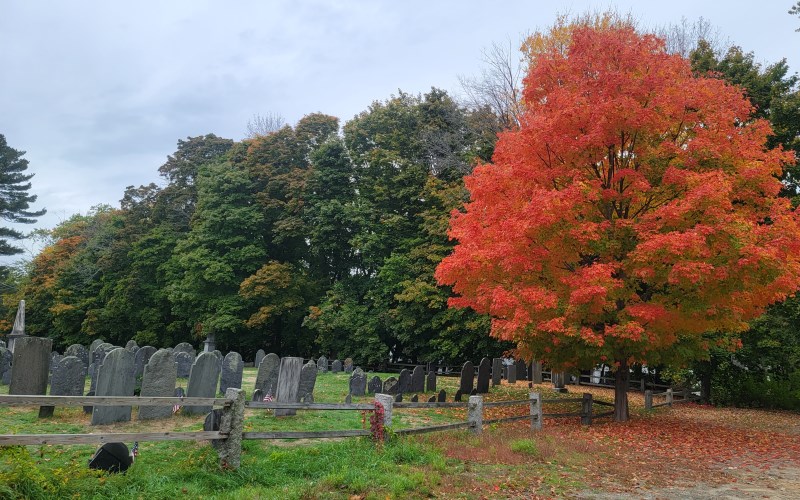
Gravestones line the ground in the area of Lexington and Concord where Samuel Prescott and others warned local farmers that the British were coming.
|
|
|
The truth, he said, is far more interesting.
Watson, a Smithsonian Fellow who has served as visiting scholar at the Pentagon, West Point and Gettysburg, came to Ketchum on the eve of the nation's Semiquincentennial — the 250th anniversary of America's founding — to share stories from his fiftieth book, "Declaration: The Story of American Independence."
He arrived fresh from a Smithsonian program the night before. And, while he had to be off the next day to another gig, he assured the audience that he would be back now that he’s discovered Sun Valley.
"You cannot find a community under 50,000 people that has a library half this nice," Watson told the audience. "You have—what--3,500 people? This is extraordinary."
|
|
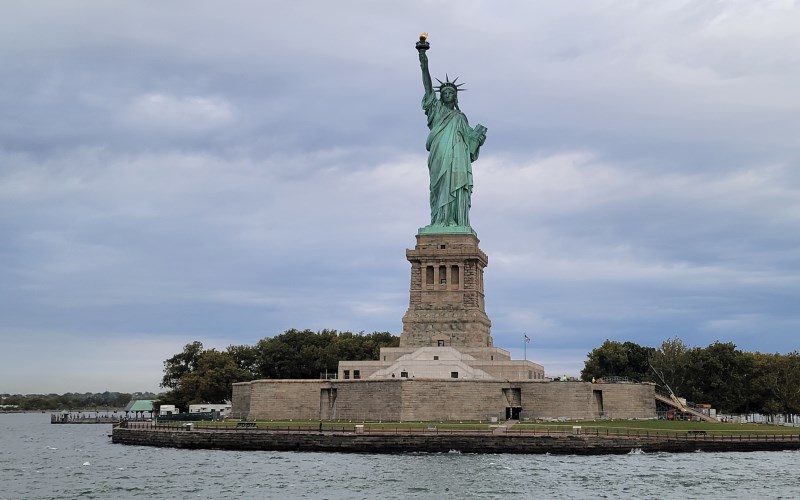
France gave the United States the Statue of Liberty to celebrate the centennial of the Declaration of Independence and the abolition of slavery.
|
|
|
From there, Watson dove into a founding story full of colorful characters, forgotten heroes and surprising twists that shatter the sanitized version most Americans learned in school.
The founding of America was a paradigm shift in human history, Watson said. For all of recorded civilization, the divine right of kings had gone unchallenged. The idea of self-determination — that you could be whoever you wanted to be rather than inherit your father's lot in life — was nothing short of heresy.
In those days, if you grew corn, your father grew corn and his father grew corn and your son would grow corn. And your daughter would marry someone who grew corn.
Thomas Jefferson, Watson said, spent 17 days in a second-story loft in Philadelphia wrestling with one question above all others: How do you justify separating from the king? It had never been done. It was an affront to God.
|
|
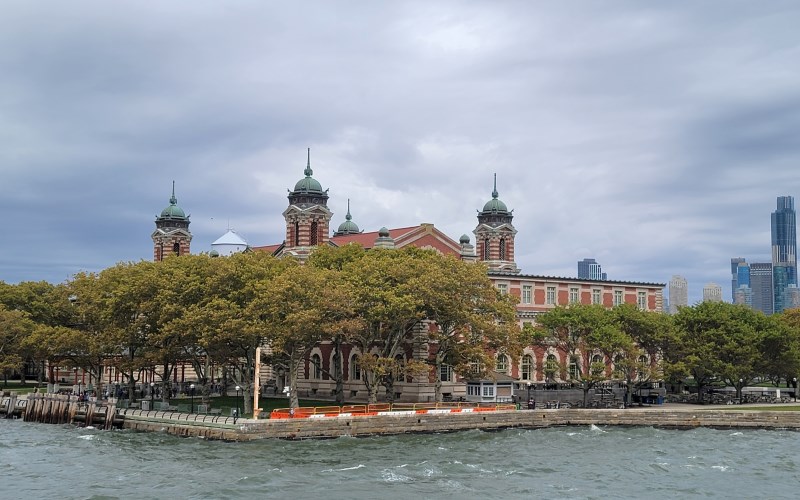
Immigrants played a major role in the establishment of the United States, ushering the way for 12 million immigrants to come through Ellis Island from 1892 to 1954.
|
|
|
He sent someone to fetch Benjamin Franklin. Ben will know what to do, he thought.
Jefferson, Franklin and John Adams turned to their intellectual Mount Rushmore — Voltaire, Montesquieu, Rousseau and Locke. And they found their answer in the concept of natural rights. If the king was not treating God's children well, the people had a God-given right to revolution.
But defining those natural rights proved thorny. The Enlightenment thinkers had identified four rights--life, health, liberty and property. But property had to go as women, the Irish, indentured servants, Native Americans and enslaved people couldn't own property. Health couldn't work either. That left the founders with half their God-given rights eviscerated.
Jefferson fetched Franklin again. And Franklin proposed a phrase that would echo through the centuries: “Life, liberty and the pursuit of happiness.”
|
|
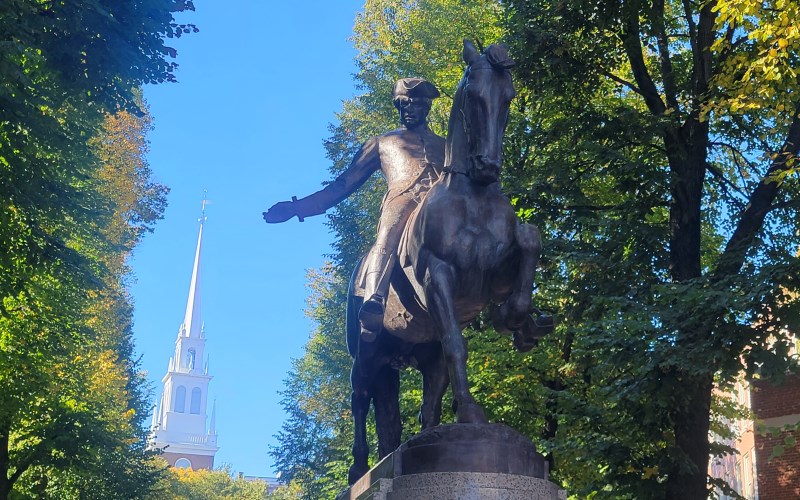
A statue of Paul Revere stands outside the Old North Church in Boston.
|
|
|
"Which is great because it means nothing," Watson said. "Or it means everything."
Happiness didn't mean ice cream, Watson said. It meant self-actualization and self-determination — the idea that you can be whatever you want to be. Franklin and Jefferson knew they might not win the war. They knew Americans might be too shortsighted to sustain self-governance.
But the pursuit of happiness was their gift to humanity, a vision that could replace autocrats and despots worldwide.
Watson then upended the audience's understanding of the Revolution's most iconic moments. The Boston Tea Party wasn't a violent insurrection, he said. It was a parade.
The Sons of Liberty marched through the streets of Boston while kids and dogs ran alongside, pipe and drum bands joined in and crowds lined up like spectators at the Macy's Day Parade. Even British customs officials watched from the sidelines.
The Sons of Liberty boarded three ships, threw the tea overboard, then cleaned up the ships and paraded back through town.
In the hold of one ship, next to the crates of tea, sat a crate of poetry by Phyllis Wheatley, a woman and former slave. The rebels threw every crate of tea into Boston Harbor, but they saved her poetry. And nobody knows why.
The Boston Massacre was equally misunderstood, Watson said. It was a riot started by a 16-year-old troublemaker named Edward Garrick who threw snowballs at a freezing teenage British soldier, got popped with a gun butt for his deed, then ran through the streets ringing church bells and screaming that the British were attacking.
The image of British soldiers lined up and firing into civilians was propaganda manufactured by Sam Adams and Paul Revere to stoke anger.
Even Paul Revere's midnight ride didn't happen the way Longfellow's poem tells it. When Dr. Joseph Warren needed two riders to warn Concord, Revere took the easy route and told William Dawes to take the dangerous one.
Revere got captured by the British. Dawes got thrown from his horse, and neither one made it to Concord. The real hero was a 25-year-old doctor named Samuel Prescott, who was cuddling with his fiancé when he spotted Revere's capture from an upstairs window, pulled on his drawers, jumped on Revere's legendarily fast horse Brownie and raced to Concord.
Thousands of minutemen heeded the call, annihilating the British. But Watson said nobody knows about Prescott because he was killed in the next battle, and Revere claimed credit for sounding the alarm.
Independence Day is not July 4, he said. It's July 2, the day the Continental Congress voted for independence. They debated Jefferson's draft on July 3 and approved the document on July 4.
John Adams wrote to his wife Abigail that generations of Americans would celebrate July 2 as Independence Day. He was wrong.
The signing of the document didn’t begin until August 2, and it took until mid-January 1777 to track down enough signers, as some of the original voters had left Congress, joined the war or couldn't be found.
In a bit of black humor, Benjamin Rush--Philadelphia's most famous physician and a signer himself—initiated an informal office pool to bet on who would be the first among them to be hanged.
Everyone picked Charles Carroll, a prominent, wealthy friend of George Washington. He had signed his name "Charles Carroll of Carrollton" so the British would know exactly which Carroll to come for.
As it turned out, Carroll was the last signer to die, living into his 90s.
That said, four New Jersey signers lost their plantations, homes and farms. The British burned everything, and some were never reunited with their families.
Another hero, an immigrant named John Dunlap, printed the first 200 copies of the Declaration when no one else would risk it, even though he knew the Continental Congress would never pay him.
Eight of the Declaration's signers were also immigrants, Watson noted, as were seven signers of the Constitution. Immigrants designed Washington, D.C., the Capitol Building and the White House.
When a second printing was needed — this time with all the signers' names on it-- a woman named Mary Catherine Goddard said she'd do it. She even put her own name on it with her address. "Baltimore in Maryland, printed by Mary Catherine Goddard" as if daring the British to come and get her.
The Redcoats never got her, but sexism did. After the war, men took her printing contracts away, saying such work should be done by a man.
Watson credited Jefferson for brilliant, poetic prose but said Franklin added between 20 and 40 percent of the final text while removing an equal amount. When Jefferson wanted to blame King George III for slavery, Franklin said it was the dumbest thing he'd ever heard.
When Jefferson attacked the British people, Franklin told him to attack the king, not the people. When Jefferson wrote, "We hold these truths to be sacred,” Franklin changed it to "self-evident," grounding the document in reason and enlightenment rather than divine proclamation.
Jefferson wrote "united" with a small “u.” Franklin made it "United States" — singular, one nation.
When Jefferson pouted about flowery passages being removed, Franklin told him, "Less is more. Now let's put on our grown-up pants."
Watson closed with the story of Adams and Jefferson, close friends who had stopped speaking for 18 years after Jefferson pillaged Adams with falsities when the two ran for President in 1800.
It was Abigail Adams who brought them back together, writing letters to both men in which she fibbed that each wanted to reconcile.
After her death in 1818, the patriots wrote letters to each other for eight years, reminiscing about the days when Franklin fell asleep in meetings and nobody dared wake him, when Hamilton spoke for five hours and everyone was furious until they realized he was right about everything and when Washington got angry and they all nearly lost their composure.
Adams and Jefferson died on the same day — July 4, 1826. It was the 50th anniversary of the Declaration, to the hour.
|