|
STORY AND PHOTOS BY KAREN BOSSICK Blue-green streamers hung from the ceiling of The Argyros on Wednesday night, rippling like the river they were meant to honor. Attendees clutching Big Woody Lagers—the Sawtooth Brewery beer named for the Big Wood River that flows through the Wood River Valley — filed past lavish tables of sandwich bites, hummus plates and tiny cupcakes before settling in for an evening that would resemble a passionate love letter to what many consider one of the valley’s most valuable resources. Project Big Wood, the nonprofit founded by Kenny Van Zant four years ago, had packed the house for its second annual State of the Big Wood event. And the message was clear: This river, which courses from the mountains north of Ketchum through the heart of the Wood River Valley to Magic Reservoir, is both thriving and threatened — and it belongs to all of us.
|
|
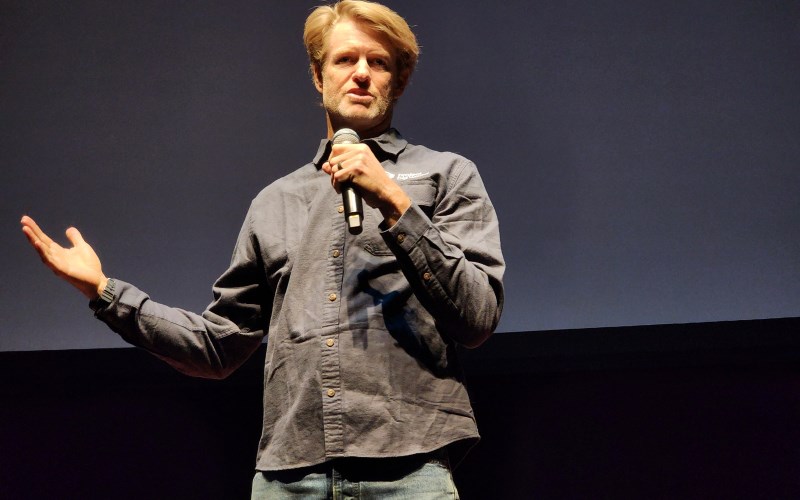
Kenny Van Zant said that the question is no longer what is happening to the Big Wood River but what must happen next to restore river function and resilience.
|
|
|
"There's nothing specifically unique about the Big Wood River in the sense that it has the same story as a lot of rivers in the West," Van Zant told the crowd during his keynote address. "We have low water. We have the impact from a changing climate. We have increased pressure of development and recreation. But what makes the Big Wood unique is that it's ours. It is our community's river. And how we treat it is a reflection of what we value." Van Zant laid out Project Big Wood's four-part strategy: data, education, advocacy and earthworks. For the first time in the river's history, the organization is now monitoring water temperature, water quality, nutrient levels and macroinvertebrate distribution across the entire system, from the Sawtooth National Recreation Area all the way past Magic Reservoir. Using LIDAR, thermal imaging and aerial photography, it has built maps that have never before existed for the valley — maps showing riparian coverage, woody debris movement, habitat diversity and floodplain connectivity reach by reach. "This information will help us, our partners and the whole community understand where the priorities are," Van Zant said. "Where are the parts of the river that need the most help? Where can investing some time and money produce the biggest results?"
|
|

Sandpoint artist Heather Mehra-Pedersen, who grew up in Sun Valley, created a painting on spot with her palette knife to be auctioned off to raise funds for Project Big Wood.
|
|
|
The evening's sobering backdrop was water — or rather, the increasing lack of it. Compared to 50 years ago, the valley's spring runoff now peaks a full month earlier. This year, across the entire West, it arrived two weeks ahead of even that accelerated schedule, putting the valley six weeks ahead of its historical average. Couple that with what Van Zant called "the super duper mega ultra El Niño out there in the Pacific," and no one in the room needed convincing that the summer ahead could be a scary one. A short film screened during the event brought the science to life. In it, experts explained that the Big Wood is a snowmelt-dominated system and that, with warmer temperatures producing less snowpack and more rain instead of snow, the river faces a future of lower flows and diminished groundwater. The snowpack, they noted, is essentially the storage reservoir for the entire basin. When it doesn't come, everything downstream suffers.
|
|

Heather Mehra-Pedersen’s trout was nearly finished at this point.
|
|
|
The film also introduced audiences to the river's tiniest but most telling residents: its bugs. Macroinvertebrates — the mayflies, stoneflies and caddisflies that form the base of the aquatic food web — serve as the canaries in the coal mine for river health. Their presence or absence tells scientists more about the state of the Big Wood than almost any other metric. "The disappearance of those really sensitive bugs is an indication that things are changing and potentially that worse things will follow," one scientist explained in the film. "It's an important signal for us as stewards." A panel discussion brought together Jean McFall, president and principal engineer of RIVHAB Engineering; Jackson Pearl, founder and executive director of the Salmon Fly Project, and Van Zant. McFall, a fish habitat engineer working closely with Project Big Wood, said the community itself is one of the river's greatest strengths. Fish populations have increased over the past decade, she noted, but numbers alone don't tell the full story.
"That's not necessarily a symbol of a really healthy river and full ecosystem riverscape," she said. The biggest biological limiting factor, she explained, is floodplain connectivity — giving the river room to spread laterally, slow down and nourish the habitat the way it did before decades of channelization and bank hardening. She referenced a famous study known as "Floodplain Fatty," which demonstrated that fish grow larger and healthier when they have access to floodplain habitat rich with organic matter, bugs, shelter and complex structure. "Getting those floodplain fatties," she said, “means restoring that lateral movement.” Pearl, known as “the bug guy of the Western United States," delivered a number that turned heads. On average, the Big Wood River watershed contains approximately 1,100 individual mayfly, stonefly and caddisfly nymphs per square foot — a figure that outshines many more famous rivers in the West.
"That's a lot of bugs," Pearl said. "And I know that because I count them." The Salmon Fly Project monitors 17 rivers across the western United States, and Pearl said the vast majority of the Big Wood shows high water quality from the bug perspective, with many sensitive species present. But USGS flow data shows 20 percent less water in summertime than there used to be, meaning less habitat for those bugs to colonize. "If you had more water in the river, if you slowed it down, the bugs would invade those areas," Pearl said. "They would flourish even more. And then there's more opportunities for those fish to feed on them." Van Zant struck an emotional chord when he talked about the Big Wood's genetically distinct Redband trout.
"I cannot believe that we get the opportunity to catch a native fish in its native range," he said. "Despite everything we could ever throw at them, including years of stocking where we had no idea — and we still do too much stocking, which is any stocking — that species has thrived and survived and is still this amazing little jewel right in our backyard that you can only catch here." He also spoke candidly about the river's most heartbreaking failure: the complete loss of connectivity to Magic Reservoir during late summer, when the river goes dry below the major irrigation diversions. "If I could wave a magic wand, it would be to meet 100 percent of the needs of our irrigator families and yet maintain permanent connectivity to Magic so that we have an actual ecosystem." On the earthworks front, Van Zant highlighted a recently approved permit for a redesigned low-head dam above the D45 diversion at the Bellevue Canal, the biggest diversion on the river. The new structure will include a fish notch allowing trout to transit the area more freely, along with secured flows during construction to maintain river connectivity.
Once complete, Project Big Wood will implement its first electromagnetic fish screen at the canal head, a technology that could dramatically reduce fish loss into the irrigation system and potentially be scaled to other diversions downstream. When the floor opened for audience questions, the packed house didn't hold back. One attendee asked about the impact of homeowners running sprinklers at noon across hundreds of acres. McFall acknowledged the evaporative loss and said conservation practices from the community would help. "This is a recreation economy in this county," added Van Zant. "All recreation that isn't directly tied to the mountain is tied to the Big Wood in some way. If we can educate homeowners that decisions they make have a literally downstream effect on the asset going past their home…” Another audience member raised the topic of beaver restoration, calling beavers "the original river restoration engineers."
McFall agreed enthusiastically but noted the balance required in urban environments. She said beaver dam analogs are a popular restoration technique but only work long-term if an actual beaver population is there to maintain them. The evening's most spirited exchange came when avid fisherman Nick Miller challenged a widely discussed Idaho Department of Fish and Game assessment that the river has "too many fish that are too small." He argued that years of the river going dry below diversions were destroying entire year classes of fish. Van Zant didn't disagree. "It's way more complicated than any one answer," he said, pointing to channelization, stocking pressure, loss of habitat and the artificial disconnection from Magic Reservoir. "We don't know what we have until we stop creating artificial environments."
Pearl added the bug perspective: Go grow big fish, you need big bugs — the larger mayflies, stoneflies and caddisflies, not just swarms of tiny midges. A Fish and Game representative confirmed that a working group has been established to potentially develop new regulations for the Big Wood. The current rules, he said, were justified 30-plus years ago when harvest was a huge part of the fishery. "We're managing a very different fishery than we were 30 years ago," he said, adding that the abundance of fish today opens up opportunities to simplify regulations and make the fishery more accessible and enjoyable for everyone. McFall offered perspective from her 26-year career working on ESA species recovery in Idaho, including chinook and steelhead in the Salmon and Clearwater basins. She pointed to the Lemhi River watershed as an example of dramatic progress, where landowners have torn down dikes and allowed the river to spread across the landscape again.
"Our West has been so altered," she said. "But there's been so much progression. And it really is working." Jean-Mari Bousquet, community outreach manager for Project Big Wood, was buoyed by the response to the evening: Restoring the Big Wood River takes time. It's a long game, but with our community in the room, the momentum is undeniable. Those who missed the event can pick up a copy of the 2026 River Report published by Project Big Wood. For more information, visit https://www.projectbigwood.org/.
|