|
STORY AND PHOTOS BY KAREN BOSSICK Devan Perez stood on the stage at The Argyros in Ketchum and told a room full of strangers that he had just landed home from Chile four days earlier. But his journey to that stage actually began in a third-grade classroom in the Wood River Valle years earlier Perez was among the 48 students targeted by the local I Have a Dream Foundation chapter, a program founded by Ken Lewis to provide afterschool academic support and enrichment to third graders in hopes of helping them graduate from high school.
|
|

Devan Perez said his studies have showed him that the person behind the art is as important as the art. His favorite so far? “An Athlete Wrestling with a Python,” an 1877 bronze sculpture by British artist Sir Frederic Leighton that launched the New Sculpture movement.
|
|
|
After graduating from high school in 2022, Perez headed to Middlebury College in Vermont. But he’s spent very little time at Middlebury itself, instead studying abroad in Denmark, Italy, Spain, the United Kingdom, Brazil and Chile while pursuing degrees in International and Global Studies and Art History with a focus on Latin American, Portuguese and museum studies. "None of those experiences would have been possible without the support that I received growing up from this program," Perez told the crowd at Far + Wise's Soaring to Success benefit. "And that is in no way an exaggeration." Far + Wise, rebranded in 2023 from the I Have a Dream Foundation, now serves more than 300 students—up from 150 students in 2023--from early elementary through high school and beyond, said Executive Director Sam Herrick. The Lewis Scholars Afterschool Program focuses on literacy and math skills while enriching students with outdoor education and career exposure. And the Center for Career Exploration helps older students explore pathways from healthcare to hospitality to skilled trades.
|
|
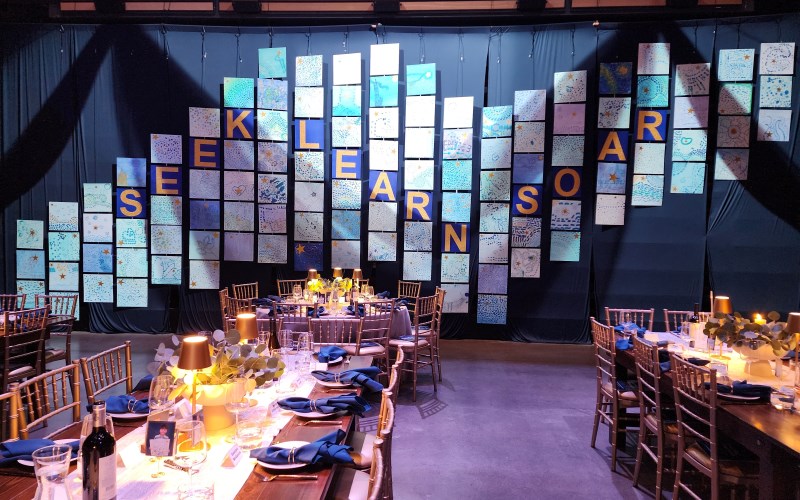
Student art touting “Seek Learn Soar” lined the walls and appeared as notes of gratitude besides dinner plates.
|
|
|
Far and Wise was also able to get 11 paid internships for its students this summer, up from three last summer. A couple of those are working on the mountain this summer getting Sun Valley’s chairlifts ready for the upcoming winter ski season. The deeper story, Herrick said, is about relationships. "I invite you to think back to your own childhood," he said. "Was there a teacher, a coach, a neighbor, or someone who saw something in you that you did not see in yourself yet? Someone who encouraged you at just the right time? Someone who truly cared? Find that person in your memories. Chances are you still remember their name." Perez's own story illustrated that point. His mother and grandparents immigrated from Mexico. His mom didn't graduate high school. His father dropped out of middle school. His parents were teenagers when he was born.
|
|
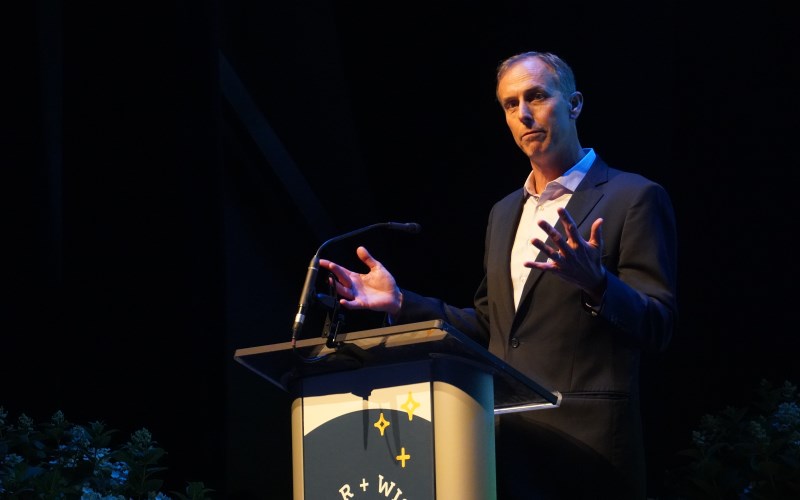
Far + Wise Executive Director Sam Herrick said those who work with his organization see the potential in each child. “We serve not just who they are today but who they can become.”
|
|
|
"There were a lot of moments growing up when my life could have gone in very different directions," Perez said. "But one thing that I had consistently growing up in this valley was this program and the adults within it who continued to show up." Perez credited Pamela Denoso and other adults in the program for offering him consistency – sometimes helping with homework, sometimes simply being there emotionally. During his senior year of high school, overwhelmed by pressure and expectations, he decided he couldn't apply to college and took a year off. When he felt ready a year later, he reached out to Denoso, who helped guide him through the college application process. "That support eventually helped me get into Middlebury College," he said, "and it's opened the door to all of these incredible experiences I've had since.
|
|
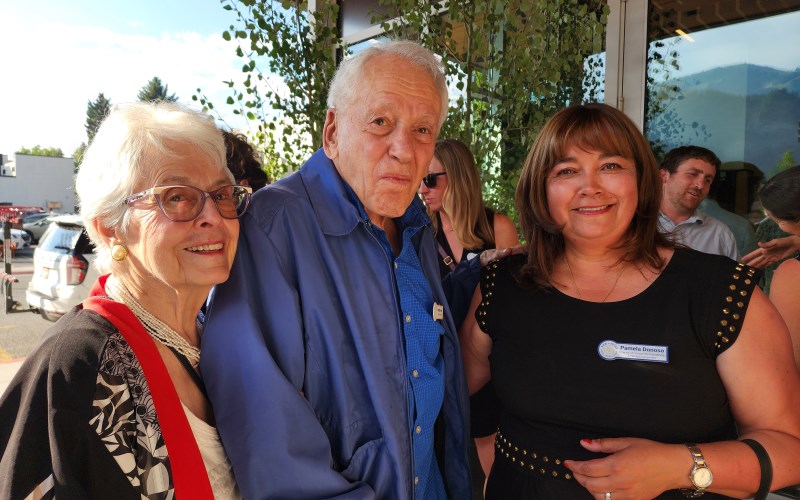
Pamela Donoso, who works in family engagement for Far + Wise, greets Far + Wise founder Ken Lewis and his wife Joyce.
|
|
|
"When you are supporting a young person who may go home to instability, your consistency in their life can make all of the difference," he added. "You may not always see the impact immediately. But that consistency gives that young person something incredible – the ability to imagine that their current circumstances do not have to determine their future." The theater, in which the benefit took place, was decorated by student art overseen by Elli Bernacchi, a Far + Wise volunteer who was an art docent and elementary art teacher for 15 years. “It’s a take-off on Van Gogh’s ‘Starry Starry Night,’ she said, “With the students creating artwork about reaching for the stars. Art helps kids in so many ways. It frees them to be creative and it helps with hand-eye coordination. Under the finesse of British auctioneer Harry Santa-Olalla, attendees bid on a Tuscany vacation for eight, a French escape for 10 and a VIP experience for four at the 2027 FIS Alpine World Cup Finals in Sun Valley.
There was even the opportunity to bid on an evening of cocktails, dinner and stargazing through the professional-grade telescope at The Observatory Sun Valley, scheduled to open this fall. Did we say the winner would be delivered in a hand-picked classic sports car from the Sun Valley Auto Club’s private collection? The evening included a moment designed to bring the mission home. Herrick asked guests open envelopes containing the responses of Far + Wise students to the question: What do you dream of becoming? The responses ranged from “a future Tesla owner” to a first grader's heartfelt words about wanting to learn to be happy for others who win. “After I graduate high school, I want to be successful in life and help my family with bills and buy them their dream car,” wrote a fourth-grader.
Thanks to the generosity of sponsors and table hosts, every dollar raised during the evening's live auction and paddle raise went directly to supporting Far + Wise students.
|